
By Andy Schmitz, Director of Horticulture and General manager
This article was originally published in The Brenton Arboretum’s Fall 2019 newsletter.
Are you looking for a plant to bring some early fall blooms to your yard? If so, the seven-son flower, Heptacodium miconiodes, would be an excellent choice. Its creamy white flowers show up in early September and persist for several weeks. Their sweet fragrance will attract a wide array of pollinators including monarch butterflies and bumblebees.
I have one planted off our deck, and every morning while it’s in bloom Frankie and I stop to check out what insects are working over the flowers before we head off to school and work. The middle of last September there were 20-some monarch butterflies in the yard, all feeding on the seven-son flower, giving them a needed energy boost for their long migration flight. It was an almost magical experience to see all of them dancing around.
The seven-son flower is native to China. It was first described as a new species in 1916 from a 1907 collection made by E. H. Wilson. Wilson was a British plant collector working for the Arnold Arboretum in Boston, Massachusetts. Viable seeds weren’t collected until 1980 when individuals from the Arnold Arboretum and U.S. National Arboretum in Washington, D.C., along with
Chinese scientists, explored Chinese native flora and brought this unique plant to North America.
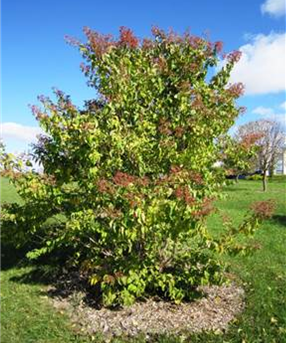
The three accessions at our arboretum were planted in 2012 and are located near the visitor parking at the Administration Building. They have multi-stemmed, shrub-like growth habits. Seven-son flower can also be pruned into a single or multi-trunked small tree. It reaches a height of 15 to 25 feet with a vase shaped growth habit when planted in full sun. If planted in a shady location, its growth is more open and irregular.
After the flowers fade and the unnoticeable fruits develop, the calyces (petal-like leaves that formed the outer layer of the flower) turn rosy red. The plant, once covered in white flowers, now glows in red for another week or so. But don’t think the display is over yet. The seven-son flower provides winter interest in your garden with exfoliating bark. The outer bark is lighter brown but shows a darker brown as it leaves papery strips of bark along the trunk.
If you can squeeze one more plant into your yard, a seven-son flower wouldn’t take up that much room and makes an excellent specimen plant. If there’s just no space left, come out to the Arboretum this fall and visit ours, you might get a close-up view of a monarch butterfly or a passing bumblebee. Either way, you’ll get to see a great plant at a time of the year when it is in its splendor.