
By Andy Schmitz, Director of Horticulture and General manager
This article was originally published in The Brenton Arboretum’s Fall 2018 newsletter.
The dictionary defines an anachronism as something that is not in its correct historical or chronological time, especially a thing that belongs to an earlier time. Have you ever thought of or noticed any botanical anachronisms? Plants out of their time are all around us.
There are many botanical anachronisms to see at The Brenton Arboretum, including Osage-orange (Maclura pomifera), ginkgo (Ginkgo biloba), honeylocust (Gleditsia triacanthos), pawpaw (Asiminia triloba), and of course my favorite, the Kentucky coffeetree (Gymnocladus dioicus), which could be classified as an extreme botanical anachronism. These plants and many more around the world evolved with large animals that dispersed their seeds. Those animals, now extinct, left these trees without their dispersal partners and out of place and time.
The sweet fruit of the pawpaw entices raccoons and opossums, but the seeds are very large and usually discarded. These days, the seeds of the Kentucky coffeetree and honeylocust need an acid treatment or filing to break the hard seed coat and allow germination. Back some 13,000 years ago, the intestinal juices or grinding molars of an American mastodon would have been just what they needed, along with some fertilizer and transportation to sprout miles away from the mother tree.
Have you ever smelled the rotting fruit of a ginkgo tree? It’s one you will not soon forget as it smells like rotting meat. Because of this smell, it’s thought the species wanted to attract carrion-eating dinosaurs to disperse its thin-walled seed, not plant-eating dinosaurs, which would have crushed and destroyed the seed. The Osage-orange tree has a very large fruit, baseball to softball size, which would have taken a mammal with a large mouth to chew and swallow it. All of these fruits are part of what’s called the “riddle of the rotten fruit,” fruit that falls to the ground waiting for an animal that will never come.
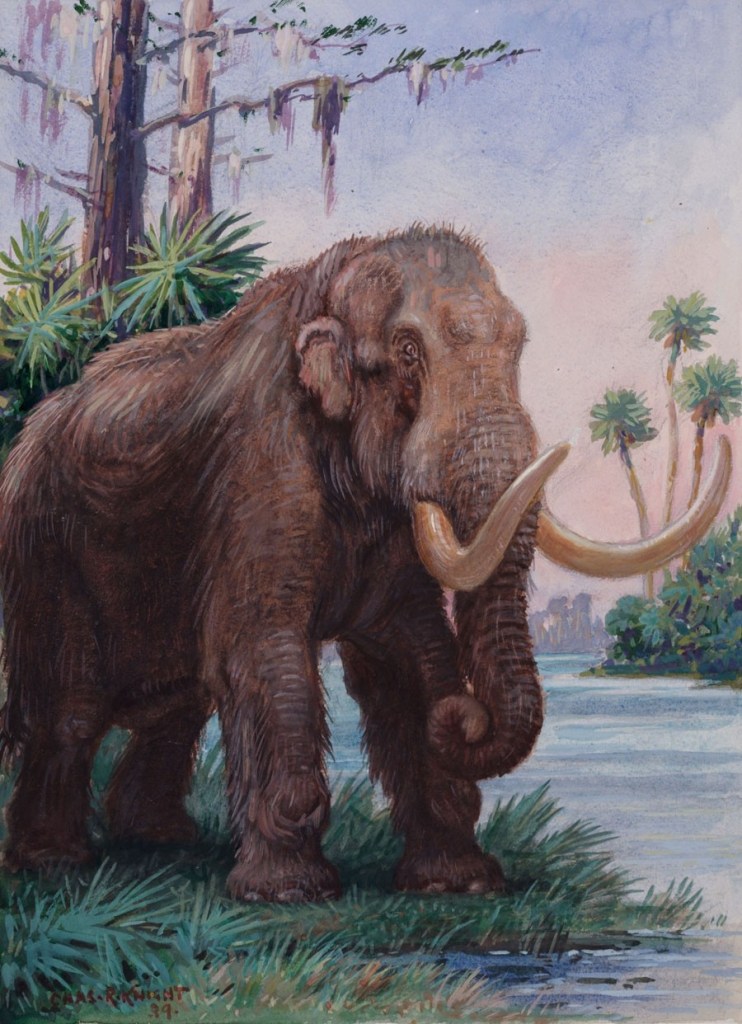
Large North American species such as mastodons, camels, rhinos, gomphotheres and dinosaurs became extinct thousands of years ago, but their botanical counterparts can still be seen at the Arboretum. This fall would be a perfect time to check them out. Be sure to notice any fruit or seeds hanging in trees or laying on the ground beneath, just waiting for some four- or two-legged creature to disperse the future offspring.
If you’re interested in the topic of botanical anachronisms, you would enjoy Connie Barlow’s book, The Ghosts of Evolution: Nonsensical Fruit, Missing Partners and Other Ecological Anachronisms. Or, if you want to plant a tree, any of these of these would make a great addition to your yard. There shouldn’t be any animals to fight off to collect the fallen fruit—or at least none larger than you!