
By Andy Schmitz, Director of Horticulture and General manager
This article was originally published in The Brenton Arboretum’s Spring 2019 newsletter.
With the road through the Arboretum closed this winter, a visit to our Osage-orange, (Maclura pomifera) collection required some hiking. But, February is the time to propagate hardwood dormant cuttings, so I grabbed the snow shoes and pruners and headed out the door.
It’s the year of the Osage-orange here, at least in regard to propagation. In our insulated, heated garage, propagation benches are up and heat mats are warming the potting soil to 70 degrees while the air temperature in the garage stays around 45 degrees so the cuttings don’t leaf out before they root. During the first few weeks in February, I made two trips to gather Osage-orange hardwood cuttings, one to south central Illinois and southeast Iowa and the other to northeast Kansas and southeast Nebraska all to look at some interesting, historical and magnificent Osage-orange specimens, most over 150 years old.
While in Illinois, I went to Oak Ridge Cemetery in Springfield with Guy Sternberg, founder of Starhill Forest Arboretum. Guy encouraged our founder, J.C. ’Buz’ Brenton and me to start working with Osage-orange over 10 years ago. Abraham Lincoln was laid to rest in this cemetery on May 4, 1865. Earlier that spring, an Osage-orange hedge row was planted along the street to the then-entrance of Oak Ridge. President Lincoln’s horse-drawn hearse went right past these newly planted Osage-orange trees. What history these trees have witnessed! After we walked past The Lincoln Tomb, we made our way to the few remaining trees. The trees are not large as they have been hedged, that is, pruned severely to create living fences in their early years, but one is fruitless and nearly thornless. This is the one we collected cuttings from and which will hopefully soon join the Arboretum’s collection to tell its story of witnessing the history of one of our greatest presidents.
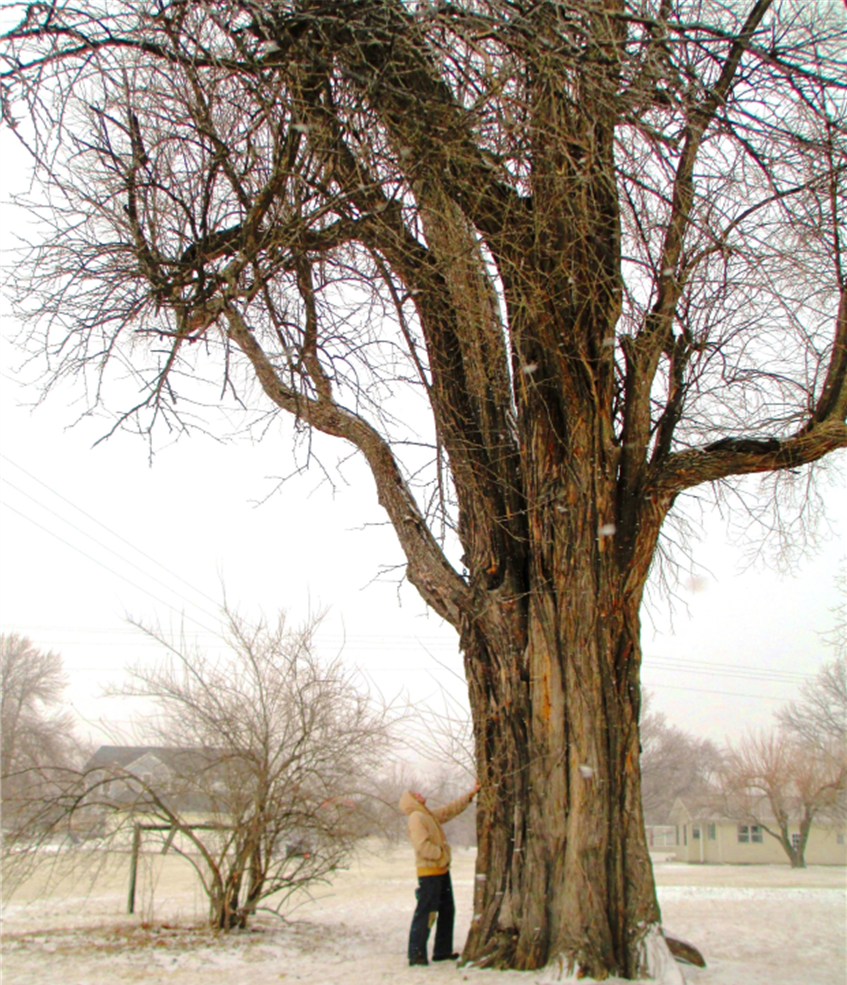
Before Iowa was officially a state, Colonel Gustavus Brackett came to Iowa in 1840 with apple seed he and his father collected from Cincinnati, Ohio cider mills and started Denmark Nursery in Denmark, Iowa, in extreme southeast Iowa. Their 1853 nursery catalog states, “All persons who have any doubts about the Osage-orange standing our winters, or answering every purpose for a hedge can satisfy themselves by calling at the Denmark Nursery, where they can see full grown hedges.” I may have missed these hedges by 165 years but I was able to see some impressive remnant Osage-orange trees most likely planted by the Bracketts around Denmark, including the current Iowa state champion which stands over 70 feet tall and is 61 inches in diameter. This is more than likely the same tree the late Al Ferguson, an Iowa nurseryman discovered around 1980 and called ‘Denmark’.
This selection is an upright grower, completely thornless as well as fruitless and has proven itself to be one of the better selections in our collection. Again, what history has this tree witnessed? Denmark has a long history with the Underground Railroad, having at least six safe hiding spots in town. Imagine being a runaway slave, stopping to rest in Denmark. There would have been no time to admire trees.
Did you know back in the late 1800s there were 39,000 miles of Osage-orange hedge rows planted in the state of Kansas? A tree was planted about every foot, so that’s almost 206 million trees planted just in Kansas. We’re not looking to plant that many here at the Arboretum but our collection already includes 63 accessions representing mostly thornless and fruitless trees. However, we have two selections, ‘Cannonball’ and ‘Bowling Ball’ which will have much larger than normal sized fruit. When you come to visit, you may want to avoid standing under these when they are mature enough to produce hedge balls.